Address
304 North Cardinal St.
Dorchester Center, MA 02124
Work Hours
Monday to Friday: 7AM - 7PM
Weekend: 10AM - 5PM
Address
304 North Cardinal St.
Dorchester Center, MA 02124
Work Hours
Monday to Friday: 7AM - 7PM
Weekend: 10AM - 5PM



How to Choose the Right High-Temperature Double-Sided Tape for Automotive and Electronics Assembly Selecting the wrong adhesive tape for high-temperature environments is one of the most expensive mistakes a procurement team can make. Tape creep, adhesive residue, and bond failure under thermal cycling cost manufacturers millions in warranty claims and production line stoppages every year. […]
Selecting the wrong adhesive tape for high-temperature environments is one of the most expensive mistakes a procurement team can make. Tape creep, adhesive residue, and bond failure under thermal cycling cost manufacturers millions in warranty claims and production line stoppages every year.
This guide breaks down the critical selection criteria, TDS parameters, and application-specific recommendations you need to specify the right high-temperature double-sided tape with confidence.
Before comparing products, you must understand which material properties actually matter for your operating environment. Not all “high-temp” tapes perform the same way.
Operating temperature range is the headline spec, but thermal cycling resistance is what separates industrial-grade tapes from consumer-grade alternatives. A tape rated for 150°C continuous exposure may delaminate after 50 heat-shock cycles if the adhesive formulation lacks cross-linked acrylic chemistry.
Key questions to ask your supplier:
– What is the continuous operating temperature vs. short-term peak temperature?
– How many thermal cycles has the adhesive been validated for?
– What is the thermal conductivity of the carrier substrate?
Peel adhesion (measured in N/25mm or oz/in) determines how well the tape grips immediately upon application. Shear strength (measured in minutes to failure under static load) predicts long-term holding power under stress.
Only compare figures measured the same way. ASTM D3330/D3330M is the most widely specified reference for 180° peel force, and its Method C is the variant written specifically for double-coated tape on a polished stainless steel panel. A supplier quoting “20 N/25mm” without naming the method is telling you very little.
For automotive applications, look for:
– Initial tack: >15 N/25mm on steel
– 180° peel adhesion: >20 N/25mm after 72h dwell
– Dynamic shear: >1,000 minutes at 80°C with 0.5 kg load
Not every adhesive bonds well to every surface. Low-surface-energy (LSE) plastics like polypropylene and powder-coated metals require modified acrylic or silicone adhesives. Always request LSE adhesion test data when bonding to non-polar substrates. For a wider look at metal and plastic substrate combinations, see our guide to choosing industrial double-sided tape for metal and plastic bonding.
The table below summarizes the key technical data sheet (TDS) parameters you should verify before specifying any high-temperature double-sided tape for production:
| Parameter | Automotive Exterior Spec | Electronics Assembly Spec | Test Method |
|---|---|---|---|
| Carrier Material | Acrylic Foam (Closed Cell) | PET Film or Non-Woven Fabric | Visual / ASTM D882 |
| Total Thickness | 0.8 – 2.0 mm | 0.05 – 0.20 mm | ASTM D3652 |
| Adhesive Type | Modified Acrylic | Silicone or Acrylic | FTIR Analysis |
| Continuous Temp. Range | -40°C to +160°C | -40°C to +200°C | IEC 60216 |
| Short-Term Peak Temp. | +180°C (30 min) | +230°C (10 min) | Internal Protocol |
| 180° Peel Adhesion | >25 N/25mm (Steel) | >12 N/25mm (Aluminum) | ASTM D3330 |
| Shear Strength (@80°C) | >1,500 min (0.5 kg) | >500 min (0.5 kg) | ASTM D3654 |
| Thermal Conductivity | 0.15 – 0.25 W/m·K | 0.5 – 2.0 W/m·K | ASTM D5470 |
| Dielectric Strength | N/A | >3 kV (0.1 mm) | ASTM D149 |
| Shelf Life | 12 months @ 23°C / 50% RH | 12 months @ 23°C / 50% RH | Industry Standard |
Pro tip: Always request batch-specific CoA (Certificate of Analysis) data rather than relying on nominal TDS values alone. Manufacturing variance in adhesive coating weight can shift peel adhesion by ±15%.
Automotive tapes face the harshest combination of UV exposure, thermal shock, and vibration. For exterior trim attachment (emblems, side moldings, spoiler bonding), specify:
– Closed-cell acrylic foam carrier for moisture sealing and stress distribution
– Modified acrylic adhesive with UV stabilizers
– Minimum 1.0 mm thickness to accommodate paint-line thickness variation
– OEM-approved grades meeting specs such as GM 6031M or Ford WSB-M15G234-A
For interior applications (instrument panel bonding, headliner attachment), prioritize low-VOC formulations to meet VDA 270 / ISO 12219 odor standards.
In PCB mounting, battery pack assembly, and LED module fixation, tapes must deliver both mechanical retention and thermal management:
– Use thermally conductive adhesive tapes with aluminum or ceramic particle fillers for heat spreading
– Specify dielectric strength >3 kV when tape bridges electrically isolated components
– Choose ultra-thin PET carriers (50–100 μm) to minimize Z-axis height in compact assemblies
– Verify RoHS / REACH compliance and halogen-free certification for EU-bound shipments
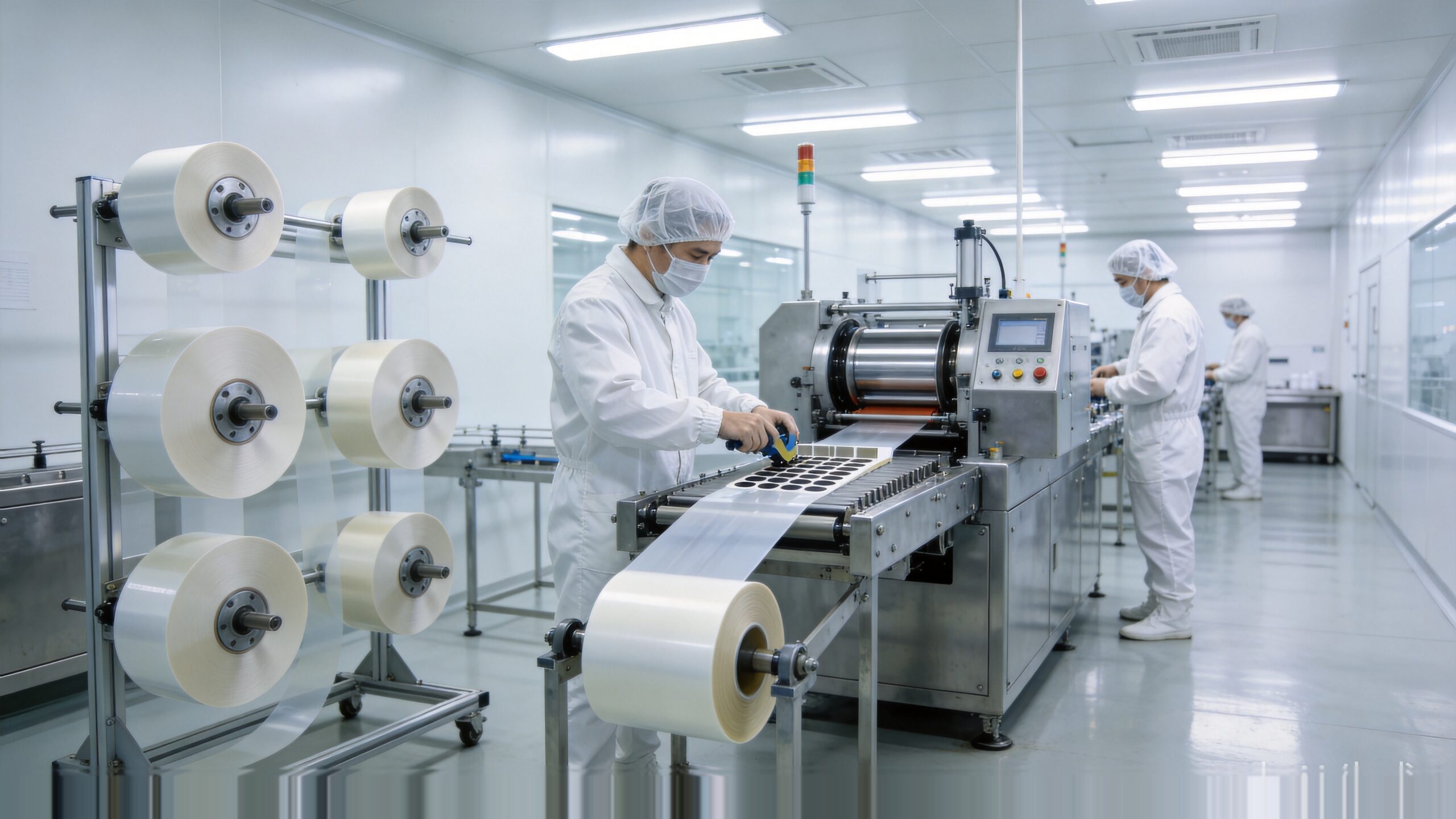
At CoreBond Tape, every roll that leaves our facility is manufactured in a Class 100,000 cleanroom environment with automated tension-controlled slitting and 100% inline thickness gauging. Our precision die-cutting capability achieves ±0.05 mm dimensional tolerance on custom shapes — critical for automated pick-and-place assembly lines.
Our engineering team provides free DFM (Design for Manufacturing) reviews on tape specification, helping you eliminate adhesive overflow in precision die-cutting, optimize release liner selection, and select the right carrier thickness for your substrate pair.
Continue with more selection guides, TDS breakdowns, and die-cutting process notes in our tape selection guides and adhesive tape technology sections.
—
Need a custom die-cut sample or technical consultation for your project? Contact the CoreBond engineering team today for free samples and fast quotes.
Written by CoreBond Tape Team

[…] tack or peel performance. For formulations that must survive extreme service temperatures, our high-temperature double-sided tape selection guide covers the matching process […]